
Ordering flanges from India for a US data center project
We make flanges in Gujarat, India, and ship them to US projects by sea. Here is what happens between your line list and the delivery, which documents travel with the flanges, and what your customs broker takes care of.
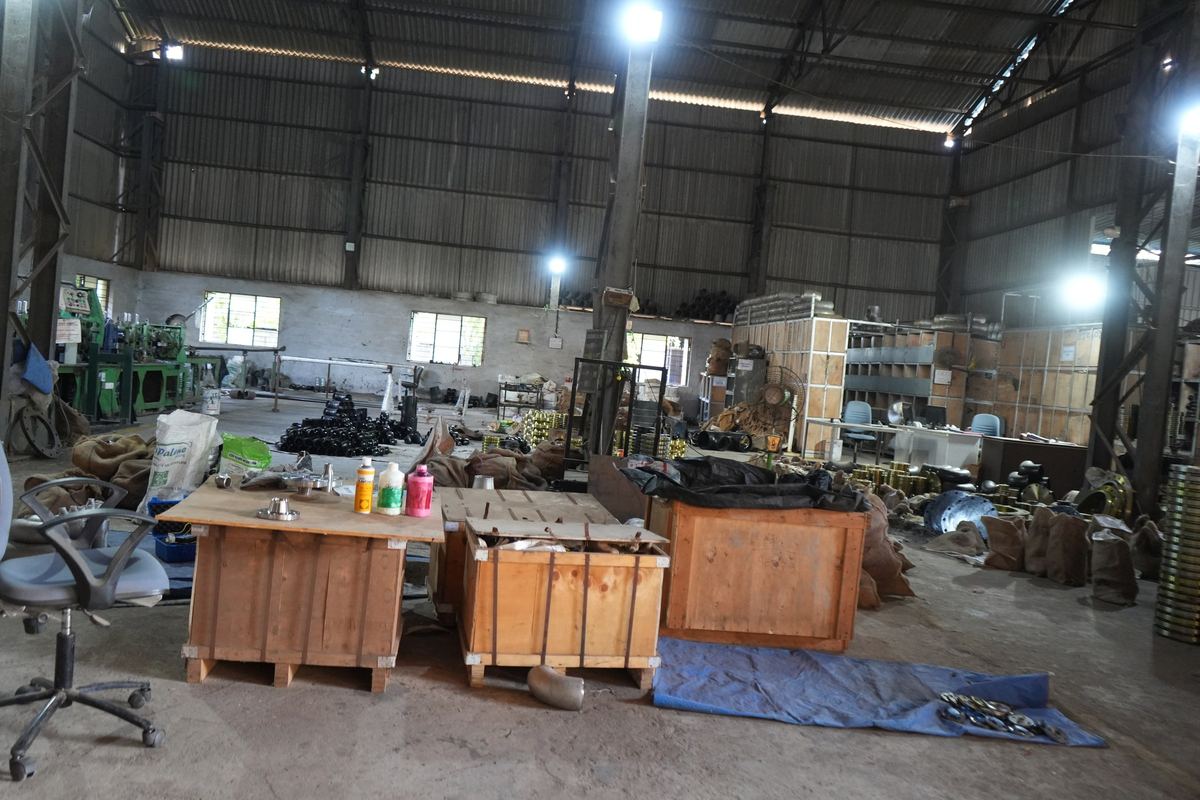
Send your line list or BOM with the standard, class, material and quantity for each line. We quote every line as specified, confirm drawings or data sheets with you, and then make, test and inspect the flanges at our works, where your inspector is welcome. Each heat ships with an EN 10204 3.1 mill test report, stainless flanges with their PMI records, in wooden export cases to the port or address you name. Your customs broker files the US entry and confirms the duties.
How an order runs
| Step | What happens | What we need from you |
|---|---|---|
| 1. Enquiry | You send the line list, BOM or marked-up drawing | Standard, class, face, size, bore or schedule, material, quantity, finishing, inspection, destination |
| 2. Quotation | We price each line as specified and flag anything we would supply differently | Incoterms and delivery point |
| 3. Order | Purchase order, then drawings, data sheets or an inspection plan confirmed | Approval of any drawings or test plan |
| 4. Manufacture | Cutting, forging, heat treatment and machining, with the heat number carried on a route card | Nothing, unless you want stage inspection |
| 5. Testing and inspection | PMI, mechanical and dimensional checks, final inspection to a 23-point checklist | Your inspector or agency, if you nominate one |
| 6. Documents and packing | Mill test reports, inspection records, packing list and invoice; wooden export cases | Any marking or packing rules for your site |
| 7. Shipment | By sea from an Indian port, on the agreed Incoterms | Your forwarder or consignee details |
Use our request for quotation form or email sales@rajendrafittings.com. For what a complete line looks like, see choosing a flange pressure class.
Documents that travel with the flanges
| Document | What it shows |
|---|---|
| Mill test report (EN 10204 3.1) | Chemistry, mechanical tests and heat treatment for each heat or lot; 3.2 when your inspector or an agency co-signs. How to read one |
| PMI record | 100% positive material identification on stainless flanges |
| Inspection report | Dimensional and visual checks against the standard |
| Packing list | Case by case: line items, quantities and weights |
| Commercial invoice | Description, quantities, values and country of origin for customs |
| Bill of lading | Issued by the carrier for the sea leg |
| Certificate of origin | On request |
Marking and packing
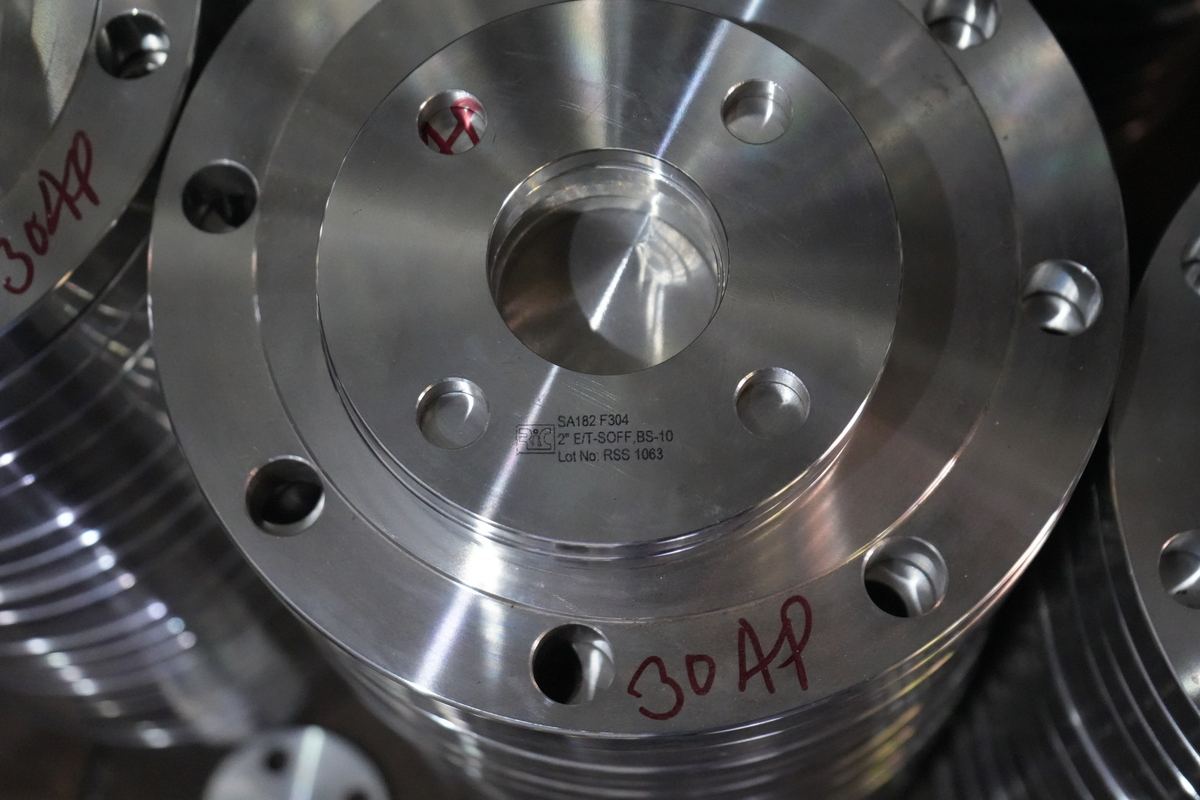
Every flange is hard stamped with RIC, the material specification and grade, size, class and the lot number printed on its mill test report, so the receiving inspector can tie each piece to its test results.
US law requires imported goods to be marked with their country of origin, and for steel pipe and pipe fittings it asks for a permanent marking such as die stamping rather than a label (19 U.S.C. 1304). Flanges are classed as pipe fittings in the tariff, under heading 7307, and ours are already die stamped, so the origin goes on with the standard marking. Your broker confirms the marking requirement for your entry.
Export orders are packed in wooden cases. Wood packaging entering the US must be treated and marked to the ISPM 15 standard (USDA APHIS). Tell us if your site has rules on case size, weight or lifting points.
Incoterms, ports and the route to site
Tell us the Incoterms and the delivery point you need, for example FOB an Indian port with your forwarder collecting, or CIF to a US port, and the quotation states exactly what is included. Containers leave from a west coast Indian port such as Nhava Sheva (JNPT) and land at the US port that suits the destination:
| Market | Usual gateway |
|---|---|
| Northern Virginia | Port of Virginia (Norfolk) or Baltimore |
| Dallas-Fort Worth | Port Houston, then truck or rail |
| Phoenix | Los Angeles and Long Beach, then truck or rail |
| Chicago | Rail from East or West Coast ports |
| Atlanta | Port of Savannah, then truck or rail |
| Silicon Valley | Port of Oakland, then truck |
| Columbus, Ohio | Norfolk or New York-New Jersey, then rail |
| Hillsboro, Oregon | Seattle and Tacoma, then truck or rail |
| New York and New Jersey | Port of New York and New Jersey |
| Reno | Port of Oakland, then I-80 by truck or rail |
Customs, classification and duties
Your customs broker files the US entry, classifies the flanges and confirms the duties that apply, including any trade remedy duties on steel products, so ask them before you place the order. Under the Harmonized System, flanges fall under heading 7307: 7307.21 for stainless steel flanges and 7307.91 for other flanges, such as carbon steel. The commercial invoice and the mill test reports give the broker the description, grade and origin they need.
Import rules and duty rates change. Treat this section as a checklist for the conversation with your broker, not as advice on a specific shipment.
Working across time zones
We work on India Standard Time (UTC+5:30), which is 9 hours 30 minutes ahead of US Eastern time in summer and 10 hours 30 minutes ahead in winter. Email sales@rajendrafittings.com or WhatsApp +91 74338 71355 at any hour, and we answer during our working day.
Frequently asked questions
Do you have a US office or stock?
No. Every order ships from our works in Umbergaon, Gujarat, India. We do not hold stock in the US, so each line is supplied to your line list and specification.
Is there a minimum order?
No fixed minimum. Small, mixed orders of a few pieces per size are welcome alongside full project packages, and every enquiry gets a reply.
Can our inspector check the flanges before they ship?
Yes. Your inspector or a third-party agency can witness stage or final inspection at our works. Agencies such as TÜV, Gulf Lloyds and IRClass have inspected our material, and EN 10204 3.2 certificates can be issued with your inspector.
Can you supply bolting and pipe with the flanges?
Yes. Stud bolts and nuts, and pipes and fittings, can be supplied with the flanges as one package. List them on the same request.
Who arranges the freight?
Either side. Tell us the Incoterms you want, for example FOB an Indian port with your forwarder collecting, or CIF to a US port, and the quotation states what is included.
Sources
- 19 U.S.C. 1304, marking of imported articles and containers
- USDA APHIS, importing ISPM 15 compliant wood packaging material
- Harmonized System nomenclature, heading 7307: tube or pipe fittings of iron or steel
- ICC Incoterms 2020