
Flanges for data center projects in Hillsboro, Oregon
Hillsboro, west of Portland, is the Pacific Northwest's main data center hub and one of the tightest markets in the US. Its mild climate favors economizers and warm-water cooling, but the 2021 heat dome showed why designs need margin. Here is what that means for the flanges.
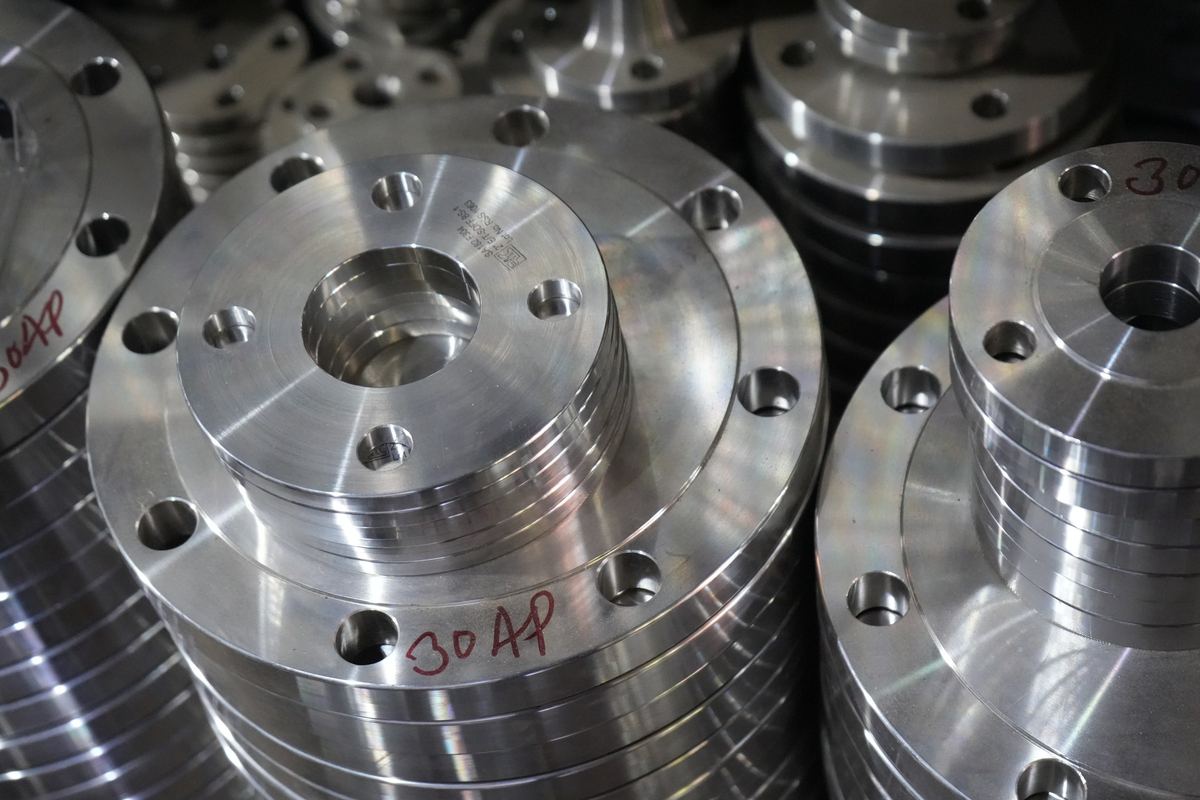
For Hillsboro data centers we supply A105 flanges to ASME B16.5 Class 150 for chilled water, facility water and dry cooler loops, and 316L stainless flanges, pickled and passivated, for CDUs and technology cooling loops. Shipments come in through the Northwest Seaport Alliance ports of Seattle and Tacoma and reach Hillsboro by truck or rail.
The Hillsboro, Oregon data center market
Hillsboro had 491.4 MW of colocation inventory in the first half of 2026 and just 1.1 MW available, with asking rates for large deployments unchanged on the year (CBRE). With so little vacant capacity, new space comes from new construction and from refits of existing halls for higher-density, liquid-cooled racks.
Climate and what it means for the piping
| Measure | Value |
|---|---|
| Hottest day in a typical year | 99.9 °F (38 °C) |
| Coldest night in a typical year | 16.8 °F (-8 °C) |
| Average July high | 82.1 °F (28 °C) |
| Average January low | 33.6 °F (1 °C) |
| Record high and low | 114 °F (46 °C) and -14 °F (-26 °C) |
Most of the year is mild: about 82 °F on an average July afternoon and about 34 °F on an average January night, with a coldest night of about 17 °F in a typical year. That suits economizers, dry coolers and warm-water liquid cooling. But on June 28, 2021, during the Pacific Northwest heat dome, Hillsboro reached 114 °F, its all-time record, so it makes sense to design heat rejection with margin for days like that.
About 36 inches of rain fall in a typical year, so outdoor carbon steel piping and flanges should be coated and kept dry under insulation jacketing. A105 is right for outdoor service: the record low of -14 °F is within its -20 °F ASME B16.5 limit.
Flange specification for Hillsboro, Oregon projects
| System | Flange | Note |
|---|---|---|
| Dry coolers and economizer loops | A105, Class 150 RF, with gaskets rated for glycol | Coat exposed carbon steel |
| Chilled water and facility water | A105, Class 150 RF, weld neck or slip-on | Blinds on header ends for later phases |
| CDUs and technology cooling system | 316L, Class 150, weld neck or lap joint, pickled and passivated, 100% PMI | Warm-water liquid cooling |
| Cooling towers and condenser water | A105, Class 150; flat face at cast iron and FRP | Full face gaskets at flat faces |
Every flange is stamped with its grade, size, class and lot number and ships with a mill test report. Send us your line list and we quote each line as specified.
Getting flanges to Hillsboro, Oregon
The Northwest Seaport Alliance ports of Seattle and Tacoma are a common gateway for the Portland area. Containers continue south by truck on I-5 or by rail to Hillsboro.
We have no US office or warehouse: every order ships by sea from our works in Gujarat, India. Documents, origin marking, packing and US customs are covered in ordering flanges from India for a US project.
Frequently asked questions
Do Hillsboro projects need low-temperature flanges?
No. The record low is -14 °F, within the -20 °F lower limit of the ASME B16.5 rating for A105.
Does the 2021 heat record affect flange selection?
Not the flanges: an A105 Class 150 flange is rated 285 psi up to 100 °F and 260 psi at 200 °F. It affects heat rejection capacity and the temperatures that gaskets and coolants must handle.
Can you supply small orders for a refit?
Yes. Small, mixed orders are welcome, with a mill test report for every heat.
Sources
- CBRE, North America Data Center Trends H1 2026 (27 August 2026)
- NOAA 1991 to 2020 climate normals for Hillsboro, Oregon, as tabulated in Wikipedia's climate table
- ASME B16.5, Pipe Flanges and Flanged Fittings: pressure-temperature ratings