
Flanges for data center projects in Northern Virginia
Northern Virginia is the largest data center market in North America, centered on Ashburn in Loudoun County. Here is what its climate and water rules mean for the cooling piping, and how flanges from our works in India reach a site there.
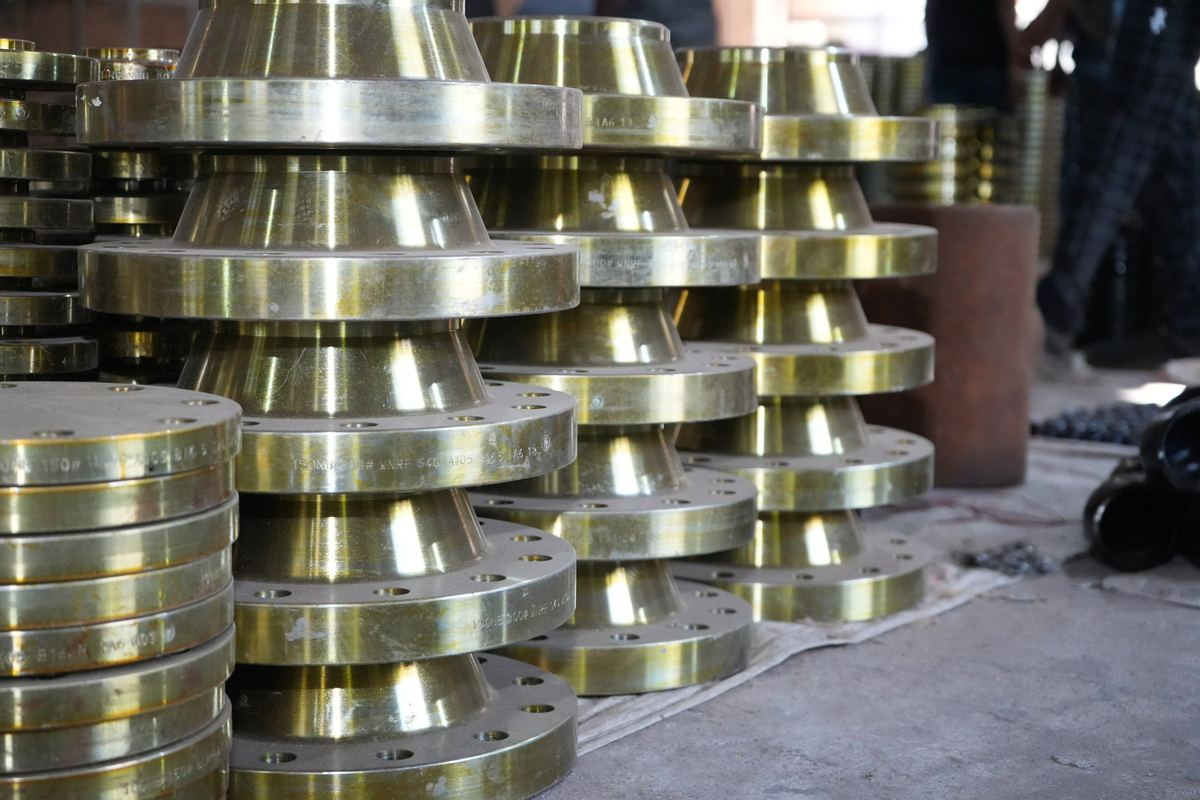
For Northern Virginia data centers we supply ASME B16.5 Class 150 carbon steel flanges in A105 for chilled water and condenser water, ASME B16.47 or AWWA C207 flanges for mains above 24 inches, and 316L stainless flanges, pickled and passivated, for CDU and technology cooling system loops. Orders ship by sea from India to the Port of Virginia or another East Coast port your forwarder chooses, then by truck to Loudoun or Prince William County.
The Northern Virginia data center market
Northern Virginia had 4,496.5 MW of colocation inventory in the first half of 2026, the most of any market in North America, with vacancy at 0.2% and another 2,420.2 MW under construction. It also led all primary markets in net absorption, and CBRE notes that land and permitting limits are now slowing construction growth here (CBRE).
Water is part of every approval. Loudoun Water built a reclaimed water system in 2010 for early data centers, and in 2025 it delivered more than 750 million gallons of reclaimed water to about 40 customers. On an average day, data centers account for 9% of the county's potable water use, and since March 2025 new data center proposals in Loudoun go through a special exception process that looks at their water impact (Loudoun County).
For the piping, that means two things. Modern facilities generally use closed loops, which lose 0 to 5% of their water against 75 to 85% for older open evaporative systems, so more heat leaves through dry coolers and air-cooled chillers on glycol loops. And where reclaimed water feeds cooling towers, the water treatment program sets the limits: carbon steel condenser water piping depends on it, and any stainless parts in that water are better in 316L than in 304L.
Climate and what it means for the piping
| Measure | Value |
|---|---|
| Hottest day in a typical year | 97.7 °F (37 °C) |
| Coldest night in a typical year | 3.8 °F (-16 °C) |
| Average July high | 87.6 °F (31 °C) |
| Average January low | 25.2 °F (-4 °C) |
| Record high and low | 105 °F (41 °C) and -18 °F (-28 °C) |
Summers are hot and humid and winters freeze: in a typical year Dulles sees about 98 °F on its hottest day and about 4 °F on its coldest night, and the record low is -18 °F. Outdoor loops that can sit idle in winter, such as dry coolers and air-cooled chillers, are normally filled with propylene glycol, so gaskets must suit glycol. See gaskets for water and glycol loops. ASME B16.5 rates A105 flanges down to -20 °F, which covers the record low here; A350 LF2 is needed only if your specification sets a lower minimum design metal temperature.
Humid summers matter inside too. Rear-door heat exchangers and technology cooling loops in the white space must stay above the room's dew point, so their supply temperature is controlled, usually by a CDU. See rear-door heat exchangers.
Flange specification for Northern Virginia projects
| System | Flange | Note |
|---|---|---|
| Cooling towers and condenser water | A105, ASME B16.5 Class 150, weld neck or slip-on; flat face at cast iron pumps and FRP towers | AWWA C207 on mains above NPS 24 |
| Chilled water plant and facility water | A105, Class 150 RF, weld neck or slip-on; ASME B16.47 above NPS 24 | Blind flanges on header ends for later phases |
| Dry cooler and air-cooled chiller loops | A105, Class 150, with EPDM or PTFE gaskets for glycol | A350 LF2 if the design minimum is below -20 °F |
| CDUs and technology cooling system | 316L, Class 150, weld neck or lap joint with stub end, pickled and passivated, 100% PMI | Same grade as the pipe; no slip-ons on the TCS |
Every flange is stamped with its grade, size, class and lot number and ships with a mill test report. Send us your line list and we quote each line as specified.
Getting flanges to Northern Virginia
Northern Virginia is served by the Port of Virginia at Norfolk and by the Port of Baltimore. The Port of Virginia also runs the Virginia Inland Port at Front Royal, west of Loudoun County: an intermodal terminal with rail service to and from its marine terminals and a US Customs port of entry. From the port, containers go to Ashburn, Sterling or Manassas by truck.
We have no US office or warehouse: every order ships by sea from our works in Gujarat, India. Documents, origin marking, packing and US customs are covered in ordering flanges from India for a US project.
Frequently asked questions
Do you have a warehouse or office in Virginia?
No. We manufacture at our works in Umbergaon, Gujarat, India, and ship each order to your site, contractor or forwarder. Every flange is made and certified for your order.
Which flanges suit phased campuses?
Blind flanges on header ends and branch take-offs, in the same class and face as the line, so later halls can connect without draining the system. Order them with the first phase.
Does reclaimed cooling tower water change the flange specification?
Not the class. Carbon steel condenser water flanges rely on the water treatment program, as the pipe does. For stainless parts in contact with reclaimed water, 316L resists pitting better than 304L. Confirm the gasket material with the water treatment supplier.
Sources
- CBRE, North America Data Center Trends H1 2026 (27 August 2026)
- Loudoun County, Data Centers: Water Considerations
- The Port of Virginia, inland ports
- NOAA 1991 to 2020 climate normals for Washington Dulles International Airport, as tabulated in Wikipedia's climate table
- ASME B16.5, Pipe Flanges and Flanged Fittings: pressure-temperature ratings