
Flanges for data center projects in Chicago
Chicago's long winters are good for free cooling and hard on outdoor piping. Here is what that means for the flanges, from the dry coolers on the roof to the stainless loops in liquid-cooled halls, and how they reach Chicago from India.
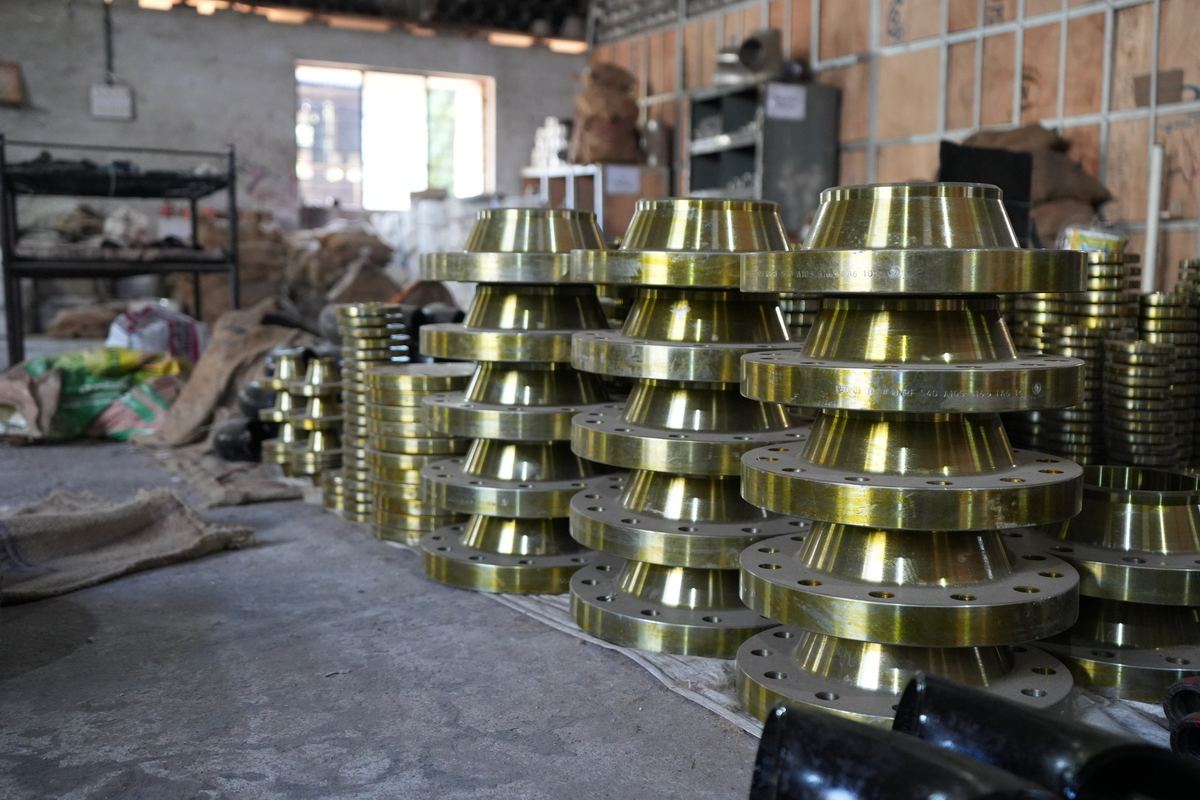
For Chicago data centers we supply A105 flanges to ASME B16.5 Class 150 for chilled water and condenser water, A350 LF2 low-temperature flanges for outdoor glycol loops whose design minimum falls below -20 °F, and 316L stainless flanges, pickled and passivated, for CDUs and technology cooling loops. Containers reach Chicago by rail from East or West Coast ports.
The Chicago data center market
Chicago had 910.6 MW of colocation inventory in the first half of 2026, with 20.0 MW available, and asking rates for deployments of 10 MW and more rose 9.7% over the year (CBRE). Campuses cluster around Elk Grove Village near O'Hare and in the western suburbs, with carrier hotels downtown.
Climate and what it means for the piping
| Measure | Value |
|---|---|
| Hottest day in a typical year | 96 °F (36 °C) |
| Coldest night in a typical year | -8.5 °F (-22 °C) |
| Average July high | 84.5 °F (29 °C) |
| Average January low | 18.8 °F (-7 °C) |
| Record high and low | 105 °F (41 °C) and -27 °F (-33 °C) |
The coldest night of a typical year at O'Hare is about -9 °F, and the record low is -27 °F. That cold is useful: economizers and dry coolers can carry much of the load for months, usually on glycol loops outdoors. It is also a design condition for every flange on those loops.
Two limits matter. ASME B31.9, the building services piping code, covers piping down to 0 °F, and ASME B16.5 rates A105 flanges down to -20 °F. Outdoor glycol piping that can cool to ambient during a shutdown may go below both. For that service the designer sets the code and the minimum design metal temperature, and A350 LF2, impact tested at -50 °F, is the flange that covers it. Indoor chilled water and technology cooling loops stay warm and use A105 and 316L as usual. See ASME B31.9 and what it means for flanges.
Flange specification for Chicago projects
| System | Flange | Note |
|---|---|---|
| Outdoor dry cooler and glycol loops | A350 LF2 where the design minimum is below -20 °F, otherwise A105; Class 150 RF | Gaskets rated for low temperature and glycol |
| Chilled water and facility water | A105, Class 150 RF, weld neck or slip-on; ASME B16.47 above NPS 24 | Indoor, so standard grades |
| Cooling towers and condenser water | A105, Class 150; flat face at cast iron and FRP; AWWA C207 on large mains | Drain and vent connections for winter drain-down |
| CDUs and technology cooling system | 316L, Class 150, weld neck or lap joint with stub end, pickled and passivated, 100% PMI | Same grade as the pipe; no slip-ons on the TCS |
Every flange is stamped with its grade, size, class and lot number and ships with a mill test report. Send us your line list and we quote each line as specified.
Getting flanges to Chicago
Chicago is the hub of the North American rail network, so containers usually arrive by rail rather than by road from a port. Shipments from India land at an East Coast port such as New York-New Jersey or Norfolk, or a West Coast port such as Los Angeles and Long Beach, and continue by rail to a Chicago-area intermodal terminal, then by truck to site.
We have no US office or warehouse: every order ships by sea from our works in Gujarat, India. Documents, origin marking, packing and US customs are covered in ordering flanges from India for a US project.
Frequently asked questions
When does a Chicago project need A350 LF2 instead of A105?
When the minimum design metal temperature of the piping is below -20 °F, the lower limit of the ASME B16.5 rating for A105. That is usually outdoor glycol piping that can cool to ambient in a shutdown. Indoor loops stay on A105.
Which gaskets suit cold glycol loops?
EPDM grades rated for the minimum temperature, or PTFE-based gaskets, checked against the glycol supplier's compatibility list. See gaskets for water and glycol loops.
Can one order mix LF2, A105 and 316L?
Yes. Small, mixed orders are welcome, and every heat ships with its own mill test report.
Sources
- CBRE, North America Data Center Trends H1 2026 (27 August 2026)
- NOAA 1991 to 2020 climate normals for Chicago O'Hare International Airport, as tabulated in Wikipedia's climate table
- ASME B31.9, Building Services Piping: scope and temperature limits
- ASME B16.5, Pipe Flanges and Flanged Fittings: pressure-temperature ratings
- ASTM A350, carbon and low-alloy steel forgings requiring notch toughness testing (grade LF2)