
Stainless ball valves for rack branches, drains and vents in US data centers
Every rack on a liquid cooling row gets two valves: one on its supply branch and one on its return. Full-bore stainless ball valves do that job, and the smaller sizes serve the drains, vents and instrument points along the loop.
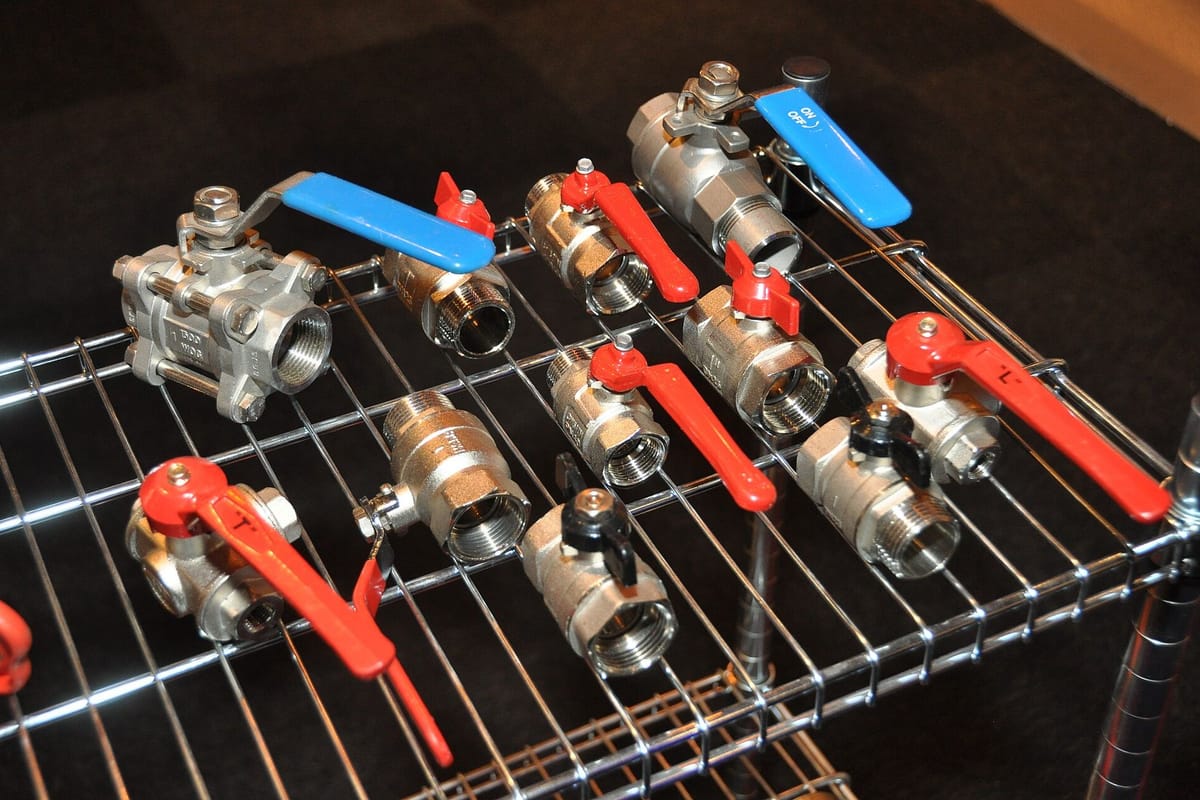
Isolate each rack branch of a liquid cooling row with a full-bore stainless ball valve on the supply and another on the return, NPS 1 to 2 (DN 25 to 50) for racks up to about 220 kW, with flanged or tri-clamp ends. Use smaller ball valves for drains, vents and instrument points. A flanged branch valve sits between two weld neck flanges; we make those, and supply the branch elbows and pipe in the same grade.
Where ball valves sit on a liquid cooling row
| Location | Size | Ends |
|---|---|---|
| Rack branch, supply and return | NPS 1 to 2 (DN 25 to 50) | Flanged Class 150 or PN 16, or tri-clamp |
| Rack manifold drain | 1/2 to 3/4 in | Threaded or weld end, shop made |
| High-point vents, manual | 1/4 to 1/2 in | Threaded; never an automatic vent above IT equipment |
| Pressure and temperature gauges, sample points | 1/4 to 1/2 in | Threaded or weld end |
| Small CDU loops and bypasses | NPS 1 to 6 | Flanged or weld end |
Branch size follows the rack's heat. At OCP's 0.4 gpm (1.5 L/min) per kW and up to about 7.5 ft/s (2.3 m/s), an NPS 1 branch carries about 55 kW and an NPS 2 branch 170 to 220 kW, which covers today's NVIDIA GB200 and GB300 NVL72 class racks of 132 to 142 kW. Our CDU to rack piping guide sizes a whole pod.
Why full bore
A full-bore valve has the same bore as the pipe, so an open valve adds almost no pressure drop. On a row, the same branch valve repeats at every rack, twice; a reduced bore would repeat its loss as many times, and the pumps would pay for it every hour the hall runs. Full bore also lets a branch be flushed at the same velocity as the pipe during commissioning; see TCS flushing and cleaning.
End connections
| End | Where it fits | Note |
|---|---|---|
| Flanged, Class 150 or PN 16 | Rack branches on welded headers | Two weld neck flanges per valve; drawings on our weld neck page |
| Tri-clamp | Prefabricated manifolds, rack hoses, CDU sanitary connections | Inspect and retighten periodically (OCP); see tri-clamp fittings |
| Weld end | Shop-built spools and skids | Welded in place; passivate after welding |
| Threaded | Small vents, drains and instruments | Shop made; OCP rules out tape and pipe dope in the loop |
Ball valves on US projects
US specifications list ball valves under CSI MasterFormat 23 05 23.12 and usually name MSS SP-110 for threaded and socket-weld ends; flanged ends follow ASME B16.5 Class 150 drilling. In US units, an NPS 2 rack branch at 56 gpm (a 142 kW rack at 0.4 gpm per kW) runs at about 4.9 ft/s, and an NPS 1 branch carries about 55 kW by OCP's rating. We quote the branch flanges and fittings, each line on a material test report.
Weld neck flanges, NPS 2, Class 150 RF, bore Sch 10S, ASTM A182 F316L, 2 pcs; elbows, 90° LR, NPS 2 Sch 10S, ASTM A403 WP316L, 2 pcs; for one full-bore ball valve, NPS 2, flanged Class 150.
Frequently asked questions
Why full-bore ball valves on rack branches?
A full-bore valve has the same bore as the pipe, so it adds almost no pressure drop to the branch. Every rack branch carries the same valve, so a reduced bore would add the same loss forty or a hundred times over and cost pump energy for the life of the hall.
Flanged, tri-clamp or threaded ends at the rack?
Flanged or tri-clamp. OCP discourages threaded joints in the field on technology cooling loops and rules out tape and pipe dope in the loop, and a tri-clamp joint should be inspected and retightened periodically. Threaded ends remain fine for small vents, drains and instrument points made up in the shop.
How many flanges do flanged branch valves need?
Two per valve. A rack with flanged supply and return valves takes four weld neck flanges, so the twenty racks of our sample pod take eighty at the branches alone. Threaded or tri-clamp branch valves need no flanges at the branch.
Can one rack be isolated while the row keeps running?
Yes, that is what the branch valves are for. Close the supply and return ball valves of the rack, drain the rack manifold through its drain point, and the row and its other racks keep running.
Sources
- Open Compute Project, Modular Technology Cooling System for "Cloud Scale", version 1.0, 25 August 2025 (1.5 L/min per kW, branch ratings, joint types)
- Vertiv, news releases on its NVIDIA GB200 NVL72 (17 October 2024) and GB300 NVL72 (11 June 2025) reference designs (132 and 142 kW per rack)
- Vertiv, Guidelines for Deployment of Single Phase Technology Cooling System, SL-80056 Rev A, February 2025 (air vents)
- CSI MasterFormat 23 05 23.12; MSS SP-110 (ball valves)