
Frequently asked questions about ordering flanges for US projects
Answers to the questions buyers ask before they send a flange schedule: how to ask for a quote, which certificates come with the flanges, who can inspect them and how they are made.
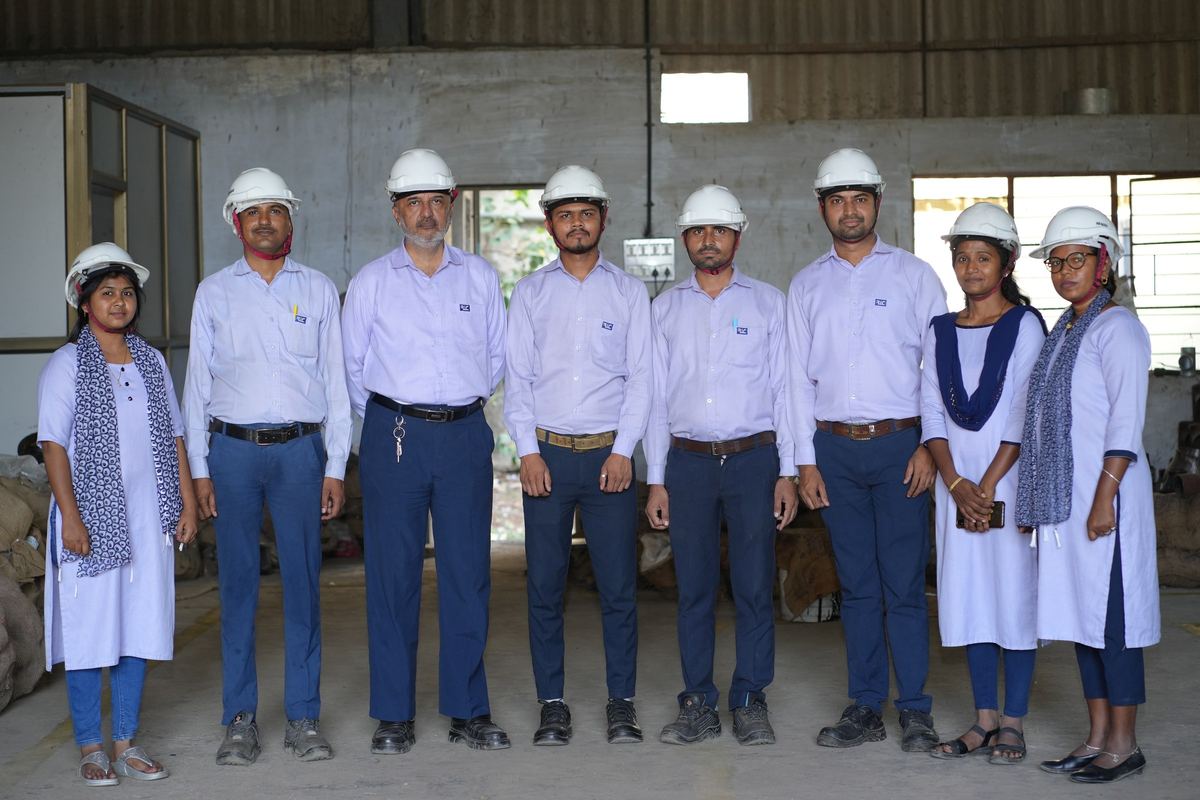
To order, send your flange schedule with the type, face, size, class, bore, material and quantity of each line; small and mixed orders are welcome. Every order ships with EN 10204 3.1 certificates, inspectors are welcome at our works in Gujarat, and stainless flanges can be pickled and passivated to ASTM A380 and A967. For US projects the certificate is your mill test report, and the flanges are die stamped with their country of origin.
Quotes and orders
How do I ask for a quote?
Send your flange schedule through our request for quotation form, by email to sales@rajendrafittings.com or on WhatsApp at +91 74338 71355. Give one line per item: type, face, size, class or PN, bore or schedule, material and quantity. Drawings and line lists can be attached to the form.
Do you take small or mixed orders?
Yes. Small, mixed orders are welcome, and every enquiry gets a reply.
Can you supply pipes, fittings and bolts with the flanges?
Yes. We supply complete packages of pipes, fittings, flanges and plates, and can quote matching stud bolts and nuts with the flanges.
Can you make parts to our drawing?
Yes. Besides standard flanges, the scope of our ISO 45001 and ISO 29001 certificates covers custom forged and machined components, so parts made to your drawing can be quoted.
Which delivery terms do you quote?
Tell us the delivery point and the Incoterms you need, for example FOB an Indian port or CIF to your port, and the quotation states exactly what is included.
Certificates and inspection
Which certificates come with the flanges?
Every order ships with EN 10204 3.1 certificates, and EN 10204 3.2 certificates with a third-party inspector can be arranged. Each certificate carries the lot number stamped on the flange: how to read one.
Can our inspector or a third-party agency witness the tests?
Yes. Inspectors are welcome at the works, and we work with agencies such as TÜV, Gulf Lloyds, IRClass, Bureau Veritas and SGS.
Which quality certifications do you hold?
ISO 9001:2015 (TÜV NORD); ISO 45001:2018 and ISO 29001:2020 (Gulf Lloyds Business Assurance); approval of our quality system as a material manufacturer under the Pressure Equipment Directive 2014/68/EU (TÜV Rheinland Polska); and NORSOK M-650 qualification for duplex and super duplex (Gulf Lloyds). Copies are on our downloads page.
Manufacturing and testing
Where are the flanges made?
At our own works in GIDC Umbergaon, Gujarat, where bar is cut, forged, heat treated, machined, tested, marked and packed. Rajendra Industrial Corporation was founded in 2000 and employs more than 100 people. Inside the works.
Which tests do you run?
Tensile, hardness, PMI, dye penetrant and dimensional checks in-house; chemical analysis, intergranular corrosion, impact, ultrasonic and magnetic particle tests at outside laboratories when the order calls for them.
Can stainless flanges be pickled and passivated?
Yes, to ASTM A380 and A967, as liquid cooling specifications ask. Why it matters.
How are the flanges marked and packed?
Each flange is hard stamped with RIC, the specification, grade, size, class and lot number. Export orders are packed in wooden cases.
Ordering for a US project
Do your certificates serve as mill test reports?
Yes. Our EN 10204 3.1 certificate is the mill test report (MTR) US specifications ask for: it gives the ASTM grade, the lot number stamped on the flange, the chemistry, the mechanical tests and the heat treatment.
Are the flanges marked with the country of origin?
Yes. Our flanges are die stamped, so the country of origin goes on with the standard marking, as US customs expects for pipe fittings. Your broker confirms the requirement for your entry.
Which US standards do you make flanges to?
ASME B16.5 and B16.47 in ASTM A182 stainless grades, A105 and A350 LF2, and AWWA C207 and C228 for water mains.
The whole route, from the line list to the US port and the customs broker, is set out in ordering flanges from India for a US project.
Technical questions
These questions have their own pages, each with tables and sources:
- Which flanges suit the technology cooling system? 316L or 304L weld neck or lap joint, pickled and passivated.
- Class 150 or Class 300? Class 150 for most data center water loops; Class 300 where static head is high.
- Raised face or flat face? Flat face against cast iron, raised face between steel parts.
- Which gasket for water and glycol? EPDM, PTFE, fiber and spiral wound compared.
- 304L or 316L? How the grades compare for coolant loops.
- Grooved couplings or flanges? Ratings, stainless limits and where each joint fits.
- What are the dimensions of a Class 150 or 300 flange? Full tables and a drawing you can download.
- How should the secondary fluid network be sized? Headers, flow per kW, balancing and testing.
- How is a TCS loop flushed before commissioning? Hydro test, cleaning, filtration and lay-up.
Terms such as CDU, TCS, FWS, PN and MTC are defined in the glossary. If your question is not here, ask it with your enquiry or on WhatsApp.