
Flanges for US food and beverage plants
Food and beverage plants combine wash-down areas, process utilities and large ammonia refrigeration systems. Each has its own flange material, and the refrigeration side has its own code.
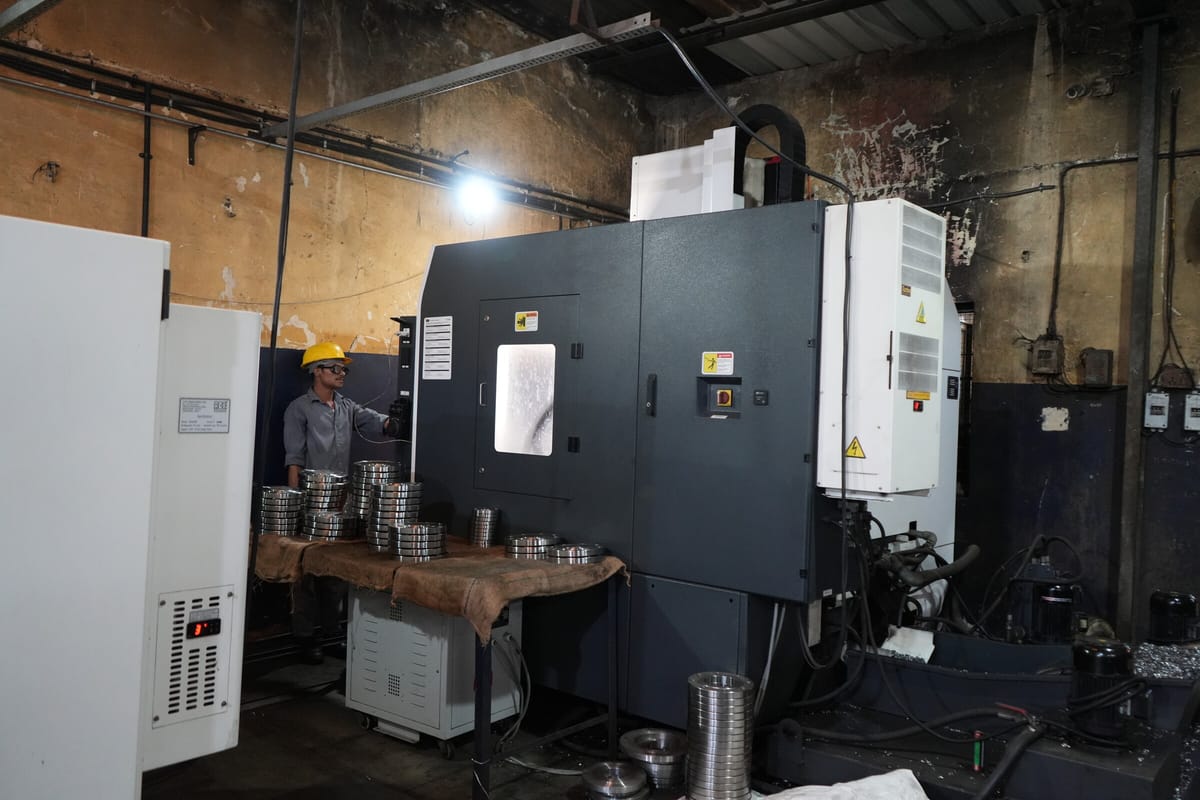
US food and beverage plants use stainless steel ASME B16.5 flanges in 304L and 316L on process utilities, CIP supply and wash-down areas, and carbon steel flanges on industrial ammonia refrigeration, which is built to ASME B31.5 and the IIAR standards: A105 above -20 °F and impact-tested A350 LF2 for the low temperature side. Product-contact lines use hygienic fittings instead. We supply ASME flanges in all of these grades, Class 150 and 300, each heat with a mill test report.
Where flanges are used in food and beverage
| System | Flange | Class and material |
|---|---|---|
| Ammonia refrigeration, high stage | Weld neck and socket weld RF | Class 150 or 300, A105 |
| Ammonia refrigeration, low temperature | Weld neck and socket weld RF | Class 150 or 300, A350 LF2 |
| CIP supply and return headers | Weld neck RF at pumps and tanks | 316L or 304L, Class 150 |
| Process water, hot water and steam | Weld neck and slip-on RF | 304L or A105, Class 150 to 300 |
| Wash-down areas and outdoor utilities | Weld neck or slip-on | 304L, 316L |
Ammonia refrigeration and low temperature steel
Industrial ammonia systems are built to ASME B31.5, Refrigeration Piping and Heat Transfer Components, and the IIAR standards. Ammonia rules out copper and its alloys, so the piping is carbon steel or stainless. ASME B16.5 rates A105 flanges down to -20 °F; below that, on low temperature suction and recirculation lines, specifications call for A350 LF2, which is Charpy impact tested at -50 °F. Tell us the design minimum temperature and the class on your specification, and we supply the grade that covers it.
Small ammonia lines, NPS 2 and below, often use socket weld flanges. We make them to ASME B16.5 in A105, A350 LF2 and stainless, bored for Sch 40 or Sch 80 pipe.
Stainless steel for wash-down and process utilities
Wash-down chemicals and humid air corrode painted carbon steel quickly, so utilities in processing rooms are usually 304L, and 316L where chlorinated sanitizers are used. Flanges in these areas are the same ASME B16.5 types as elsewhere, often pickled and passivated so the surface does not rust before the line goes into service.
What we do not supply
Product-contact lines use hygienic tube and clamp fittings to 3-A or ASME BPE, which we do not make. Our flanges serve the utilities, refrigeration and equipment connections around them.
Ordering for a US project
Send your line list with the standard, type, size, class, bore or schedule, facing, material and quantity for each line, and we quote every line as specified. Every order ships from our works in Gujarat, India; we have no US office or warehouse. Each line is supplied to your line list, and ordering from India explains the documents, marking, packing and customs.
Frequently asked questions
What flange grade is used for ammonia refrigeration?
A105 carbon steel down to -20 °F and A350 LF2, impact tested at -50 °F, for colder service. Follow your engineer of record and the IIAR standards for the class and grade on each line.
Do you make socket weld flanges?
Yes, to ASME B16.5 in A105, A350 LF2 and stainless, NPS 1/2 to 3, bored for the pipe schedule you give.
Do you supply sanitary fittings?
No. We make ASME flanges and forged fittings for utilities and refrigeration, not hygienic product-contact fittings.
Sources
- ASME B31.5, Refrigeration Piping and Heat Transfer Components
- IIAR 2, the IIAR standard for the design of closed-circuit ammonia refrigeration systems
- ASME B16.5, Pipe Flanges and Flanged Fittings, NPS 1/2 through NPS 24
- ASTM A350/A350M, Carbon and Low-Alloy Steel Forgings, Requiring Notch Toughness Testing for Piping Components