
How to read flange markings, from the ASTM grade to the MTR
A forged flange carries its identity stamped on the rim: the maker's mark, the size, the pressure class or PN, the type and facing, the material grade and the heat number. Read in that order, the stamp says what the flange is and which certificate belongs to it.
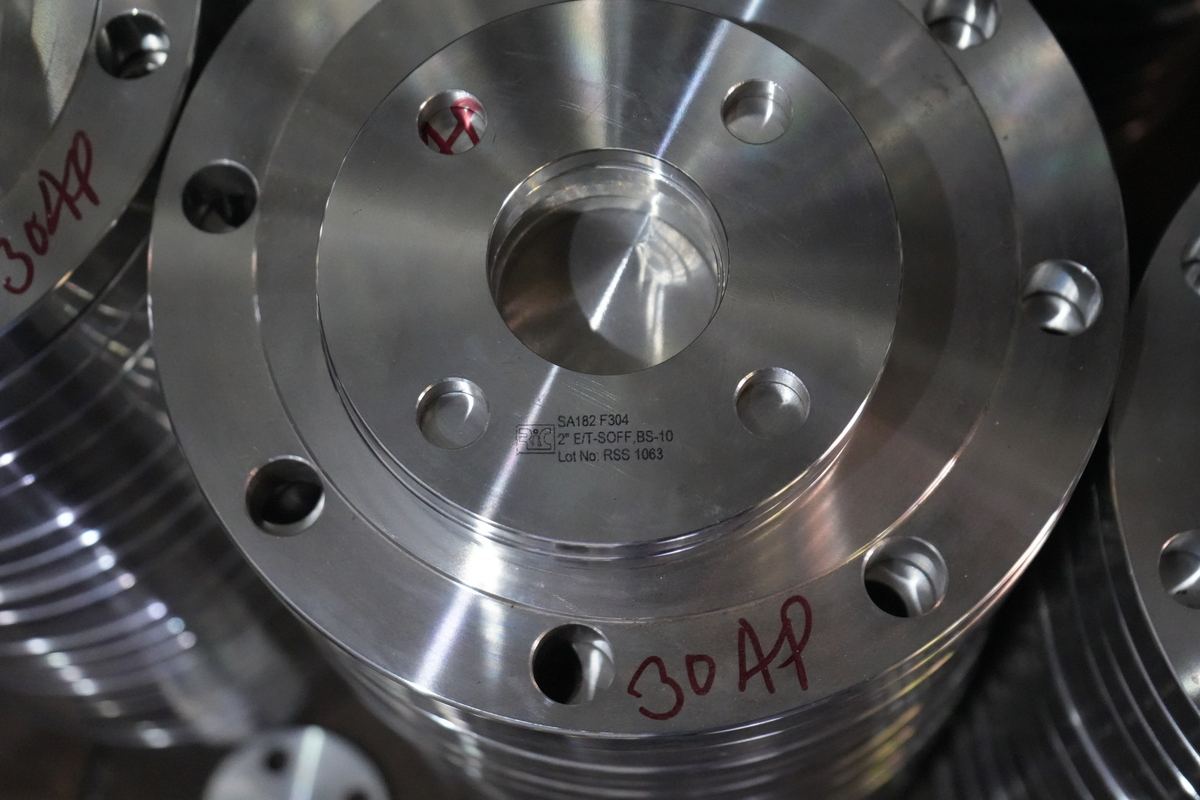
A forged flange is stamped on its rim with the maker's mark, the size, the pressure class or PN, the type and facing, the material specification and grade, the heat or lot number and the standard it is made to. The heat number is the link to the mill test certificate, which proves the chemistry and the tests of that heat; read together, the stamp and the certificate tell you what the flange is and what it is made of.
An example: the marking on our flanges
An NPS 4 Class 150 weld neck flange in 316L, bored for Sch 40S pipe, is marked in two lines:
RIC 4" 150 WN RF SCH 40S
ASTM A182 F316L HT 24F118 ASME B16.5
and its EN 1092-1 counterpart, DN 100 PN 16 type 11 with a B1 raised face:
RIC DN 100 PN 16 11/B1
1.4404 HT 24F118 EN 1092-1
The heat number here is a sample; on a delivered flange it is the heat of the bar the flange was forged from. Our flange 3D models show this marking on the rim of every size and class, and the marking line of our certificates repeats it, so each flange can be matched to its certificate.
| Mark | What it says | Other values you may see |
|---|---|---|
| RIC | The maker's name or trademark | Every maker has its own |
| 4" or DN 100 | Nominal size: NPS on ASME flanges, DN on EN flanges | 1/2" to 24", DN 15 to DN 600 |
| 150 or PN 16 | Pressure class (ASME) or nominal pressure (EN) | 300, 600, 900, 1500, 2500; PN 6 to PN 100 |
| WN, RF or 11/B1 | Flange type and facing | SO slip-on, BL blind, LJ lap joint, SW socket weld, THD threaded; FF flat face, RTJ ring type joint; EN types 01 and 05, facings A and B1 |
| SCH 40S | Weld neck bore: the pipe schedule it matches | SCH 10S, STD, XS, SCH 80, SCH 160 |
| ASTM A182 F316L or 1.4404 | Material specification and grade | A105, A350 LF2, A182 F304L, F51, F53; 1.4307 |
| HT 24F118 | Heat or lot number, the link to the certificate | Any letters and digits the steel maker or forge assigns |
| ASME B16.5 or EN 1092-1 | The dimensional standard | B16.47, B16.36, MSS SP-44 |
How the stamp goes on, in our film: Marking and traceability, from 2:08.
What the standards ask for
ASME B16.5 refers marking to MSS SP-25, which asks for the manufacturer's name or trademark, the material as its ASTM specification and grade, the class, the size and "B16" or "B16.5" next to the class. A ring type joint flange is also marked on its edge with R and the ring groove number, and a temperature marking is optional. The ASTM material specifications for forged flanges, such as A105, A182 and A350, add the heat number. EN 1092-1 flanges carry the same information in European form: DN and PN, the type and facing (11/B1), the material number or name (1.4404 or X2CrNiMo17-12-2) and the standard.
Reading the material marks
- A or SA. ASTM A182 is the ASTM specification; SA-182 is the same specification adopted in Section II of the ASME Boiler and Pressure Vessel Code, which code work asks for.
- L and H. F304L and F316L are low carbon grades, at most 0.030% carbon, for welded systems; F304H and F316H are high carbon grades for high temperature strength.
- LF2. ASTM A350 LF2 is a carbon steel for low temperatures; Class 1 is Charpy impact tested at -50 °F (-46 °C).
- N after A105. A105N marks a normalized A105 forging.
- F51 and F53. Duplex (UNS S31803) and super duplex (UNS S32750) stainless steels in ASTM A182.
- Two grades in one mark, such as F304/F304L, mean the steel meets the limits of both grades, and the certificate should say so.
The heat number and the certificate
The heat number follows the steel from the mill to the flange. The bar arrives with its maker's certificate; its heat goes onto our route card before the first cut, stays with the flanges through forging, heat treatment and machining, and is stamped on each one at the end. The EN 10204 3.1 certificate we issue for the delivered flanges carries the same number with the chemistry, the mechanical tests and the heat treatment, and its marking line repeats the stamp. To check a flange on receipt, read the stamp, find the heat on the certificate and compare the grade, size and class with the order; positive material identification (PMI) of the flange confirms the grade. If the certificate for flanges from us has gone missing, request a copy with the number on the stamp.
A stamp can be misread, worn or, on flanges of unknown origin, simply wrong. For anything critical, accept a flange only with a certificate whose heat number matches the stamp, and check the grade by PMI where the line calls for it.
Marks that are often misread
- The class is not a pressure. Class 150 does not mean 150 psi: at ambient temperature an A105 flange in Class 150 is rated 285 psi (19.6 bar) and an F316L flange 230 psi (15.9 bar), and both fall as the temperature rises. Our guide to choosing a pressure class works through it.
- The size is nominal. 4" is NPS 4, whose pipe is 4.5 in (114.3 mm) across; DN 100 is the metric name of the same size, but an EN 1092-1 DN 100 flange is not drilled like an ASME NPS 4 flange.
- A schedule on a slip-on is unusual: the schedule belongs on weld neck and socket weld flanges, whose bore follows the pipe.
When the stamp cannot be read
Paint, rust and grinding wipe out stamps on flanges that have been in service. Clean the rim with a wire brush and read it at a low angle with a torch; if it is gone, the size and class can still be found from four measurements with our flange identifier. The material then needs a PMI test, and the heat is lost, so a replacement is ordered by the line's specification rather than copied from the old flange.
Marking on US projects
On a US job the receiving inspector checks the stamp against the purchase order and the mill test report (MTR): ASTM grade, class, size, facing, bore schedule and heat number. Imported flanges must also show their country of origin permanently, and die stamping does it, so ours carry it with the standard marking; ordering from India covers the documents and the customs rules. Work under the ASME Boiler and Pressure Vessel Code calls for SA materials, so name the specification you need on each line of the order.
Questions about flange markings
What does HT mean on a flange?
HT is short for heat: the number after it identifies the melt of steel the flange was forged from. The same number is on the mill test certificate, which gives that heat's chemistry and test results.
Does Class 150 mean the flange is rated for 150 psi?
No. The class is a rating designation; the pressure allowed depends on the material and the temperature. At ambient temperature a Class 150 flange in A105 is rated 285 psi (19.6 bar) and one in F316L 230 psi (15.9 bar), and both ratings fall as the temperature rises.
What is the difference between F316 and F316L on the stamp?
The L grades are low carbon: ASTM A182 F316L allows at most 0.030% carbon against 0.08% for F316, which keeps the steel resistant to intergranular corrosion after welding. Their strength and pressure ratings differ, so the stamp has to match the grade the line calls for.