
How our flanges are made, from bar to MTR
One forged weld neck flange, followed through our works in India from the certified bar to the certificates that ship with it, in 4 minutes 20 seconds.
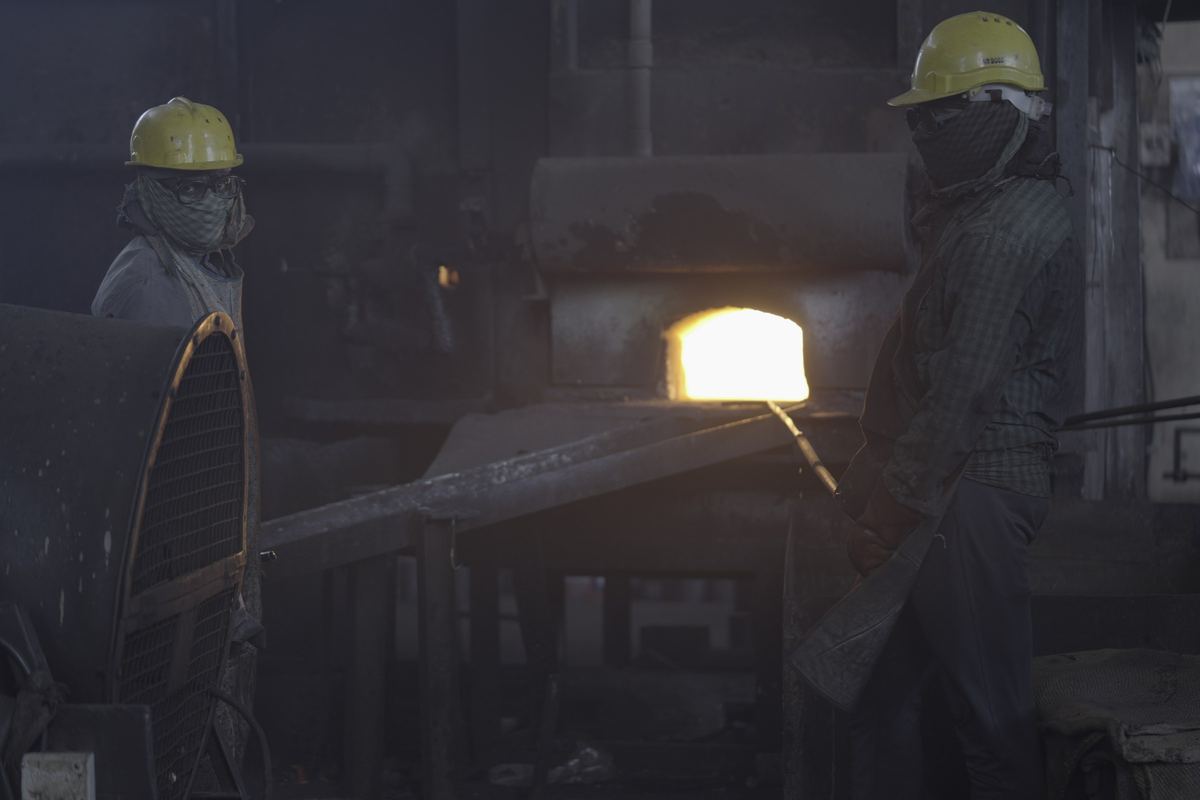
The film follows one forged weld neck flange through our works: certified bar and its heat number, furnace heating and closed die forging, heat treatment, pickling, CNC machining, marking, testing, the 23-point final checklist and the certificates that ship with every order. Pick a chapter below to start there.
Chapters
- 0:00 From bar to flange
- 0:16 Our works
- 0:30 Certified bar and the heat number
- 0:53 Furnace and closed die forging
- 1:19 Heat treatment
- 1:35 Pickling and passivation
- 1:47 CNC machining
- 2:08 Marking and traceability
- 2:19 Testing
- 2:47 Final checks and certificates
- 3:22 Flange types and standards
- 3:54 Where our flanges go
- 4:09 Rajendra Industrial Corporation
The process in US terms
US piping specifications call for flanges by ASTM grade and ASME B16.5 class, with a mill test report.
- Certified bar (0:30). ASTM A182 F304L and F316L, duplex and super duplex, and ASTM A105 and A350 LF2 carbon steel bar arrive with the mill's certificate. The heat number goes onto our route card RIC/PRD/RC-01 before the first cut.
- Closed die forging (0:53). The hammer weighs 1.25 metric tons (about 2,760 lb); the presses are 300 and 150 metric tons (about 330 and 165 US tons). Closed dies give the hub and rim a grain flow that follows the flange.
- Heat treatment and pickling (1:19, 1:35). Solution annealing of stainless grades and the heat treatment each ASTM specification calls for on carbon steel, recorded on furnace charts; pickling, with passivation to ASTM A380 and A967 when your spec asks for it.
- Machining and marking (1:47, 2:08). Face, gasket finish and bore to the pipe schedule on CNC machines, bolt holes on the B16.5 bolt circle, then the stamp on the rim: RIC, size, class, type and facing, grade and heat number.
- Testing and the MTR (2:19, 2:47). A 400 kN (about 90,000 lbf) universal testing machine for tensile tests, hardness, PMI, dye penetrant and dimensions in our lab; the 23-point final checklist; and the MTR to EN 10204 3.1, or 3.2 with your inspector's witness.
Transcript
0:00 From bar to flange
This is a forged weld neck flange. Before it was bolted into a pipeline, it was a steel bar at our plant in India. Here is how Rajendra Industrial Corporation makes it.
0:16 Our works
RIC has forged and machined flanges since 2000. Cutting, forging, heat treatment, pickling, machining and marking are all done in house.
0:30 Certified bar and the heat number
Every flange starts as certified bar: stainless 304L and 316L, duplex and super duplex, and carbon steels A105 and A350 LF2. Its heat number goes onto a route card and stays with the part to the end. Band saws cut the bar into billets.
0:53 Furnace and closed die forging
Each billet is heated in a furnace until it glows. It is then forged in closed dies. A 1.25 tonne hammer and presses of 300 and 150 tonnes force the hot metal to fill the die. Forging leaves a dense structure, with the grain following the shape of the flange.
1:19 Heat treatment
Next comes heat treatment, recorded on a furnace chart. Stainless and duplex forgings are solution annealed and quenched. Carbon steel gets the treatment its specification calls for.
1:35 Pickling and passivation
Stainless parts are pickled to remove scale, and can be supplied passivated to ASTM A380 and A967.
1:47 CNC machining
The forgings then go to our CNC machines. Each one is faced, the raised face is cut with its gasket finish, and the bore is machined to the pipe schedule. Vertical machining centers drill the bolt holes on the bolt circle.
2:08 Marking and traceability
Each flange is marked with its size, class, material and heat number, so it can be traced back to its bar.
2:19 Testing
In our lab, a 400 kN universal testing machine pulls tensile samples. We check hardness, confirm the alloy with a PMI analyzer, and look for surface cracks with dye penetrant. Dimensions are checked against the standard. Chemical, intergranular corrosion, impact, ultrasonic and magnetic particle tests go to outside laboratories.
2:47 Final checks and certificates
Before dispatch, every order passes a 23-point final checklist. It ships with EN 10204 3.1 test certificates, or 3.2 when a third-party inspector witnesses the tests. We are certified to ISO 9001, ISO 45001 and ISO 29001, approved as a material manufacturer under the PED, and qualified to NORSOK M-650 for duplex and super duplex.
3:22 Flange types and standards
We make weld neck, slip-on, blind, lap joint, socket weld, threaded, ring type joint and long weld neck flanges, orifice flanges and spectacle blinds. ASME B16.5 from 1/2 to 24 inches in Class 150 to 2500, larger sizes to B16.47, and EN 1092-1 from PN 6 to PN 100.
3:54 Where our flanges go
They are made for data center cooling loops, chilled water and district energy, oil and gas, refining, power and water systems.
4:09 Rajendra Industrial Corporation
Rajendra Industrial Corporation. Forged flanges, traced to the heat.
About the film
We made this film in November 2026. The factory footage comes from our 2023 company film, shot at the works, which is also on the factory page. The 3D sequences show what a camera cannot: the closed die in section, the grain flow and the marking. The narration is a synthetic voice, with English captions. The dimensions behind every flange in it are the ones in our drawings and our flange 3D models.
For US buyers
The chapter on final checks shows the certificate that ships with every order. In the US it is called the mill test report (MTR): EN 10204 3.1, issued by our quality department, or 3.2 when your inspector witnesses the tests. Its marking line matches the stamp shown in the marking chapter, so a receiving inspector can match each flange to its MTR. Our sample MTR shows every field, and ordering from India covers the documents for a US shipment.